


Be the first to join. Keep the badge forever.
The first members of this community earn permanent Founding Member status. It shows on your profile and your dog's profile for as long as you're here.
- ✓Founding Member badge on your profile
- ✓Your dog featured first
- ✓First Dog of the Month nomination
- ✓Always free
⭐ Founding Member spots open
First to join gets the badge
🐕 Be the first dog registered
Add your Lab to the community
📷 Add the first photo
Start the photo wall
8
Discussions
0 members
8 discussions
About the Huskydoodle
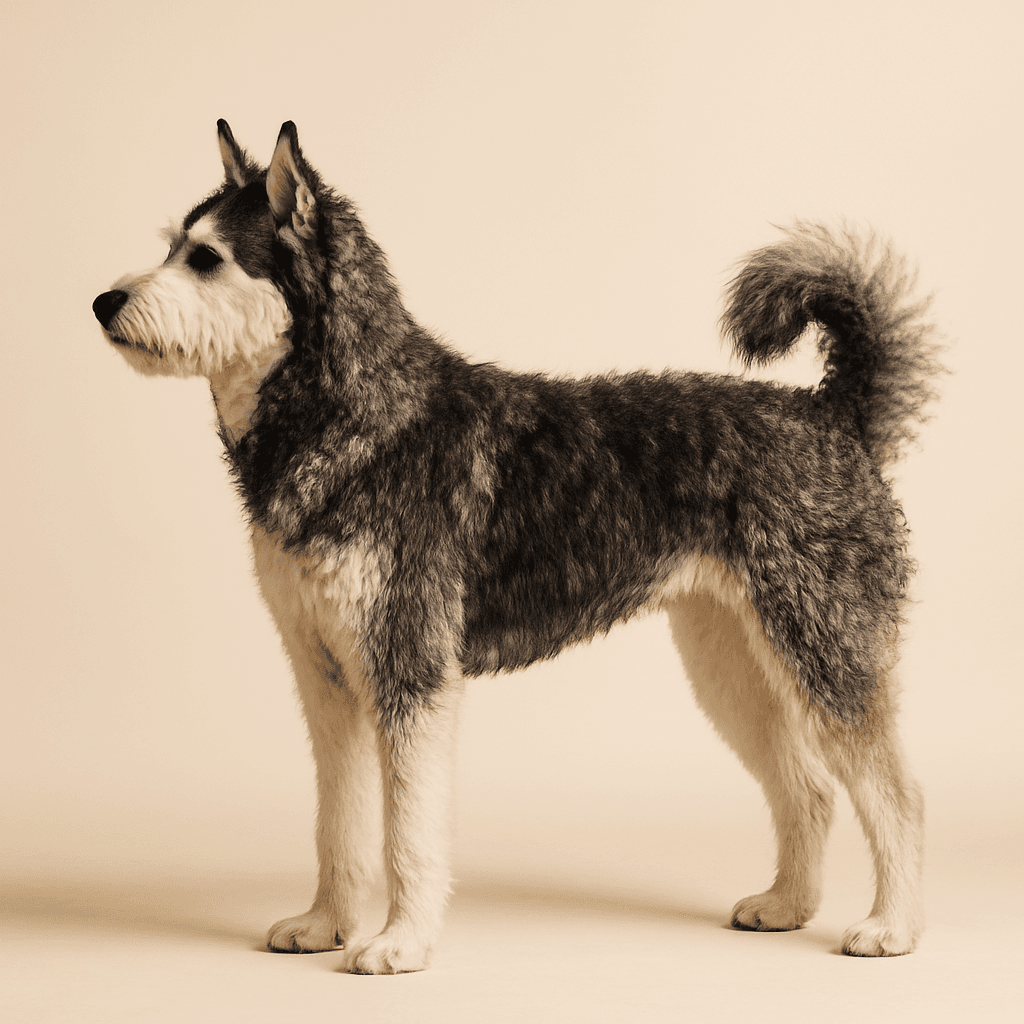
The Huskydoodle is a crossbreed produced from a Siberian Husky and a Poodle - typically a Standard Poodle - combining two breeds of very different character and working background into a single striking package. The cross was developed with the intention of combining the Siberian Husky's dramatic appearance and endurance with the Poodle's intelligence and reduced-shedding coat, producing an energetic companion dog with appeal to owners drawn to both parent types. The crossbreed is not recognised by the Kennel Club and has no formal breed standard, breed club or mandatory health testing programme, which means quality and health status vary significantly between breeders and individual dogs. Appearance varies considerably between individuals. Coat type ranges from the loose wavy coat of a Husky-influenced dog to the tightly curled coat of a Poodle-influenced one. The characteristic Husky colouring and distinctive pale eye colour can be expressed to varying degrees. Size is medium to large - Standard Poodle crosses typically weigh 20 to 35 kilograms. The reduced-shedding characteristic associated with the Poodle is not guaranteed in every individual, and prospective owners should not assume any cross will be genuinely low-shedding. The character reflects two very different working temperaments. The Poodle contributes intelligence, sociability and a genuine desire to engage with training. The Siberian Husky contributes high energy, independence, strong predatory drive and the characteristic selective responsiveness of a sled dog that was bred to make autonomous decisions rather than defer to human direction at every turn. The result is a dog that can be charming, playful and highly engaging but also demanding, independent and genuinely challenging for owners without experience of high-drive northern breeds. Exercise needs are substantial. The Husky influence means this crossbreed has real working drive and endurance, and under-exercise reliably leads to destructive behaviour, excessive vocalisation and difficulty managing. A minimum of 1.5 to 2 hours of vigorous daily activity is appropriate for most individuals. Recall training is genuinely challenging and exercise should be conducted in securely fenced areas as a general rule. The curlier coat types require professional grooming every six to eight weeks to prevent matting, adding significantly to ongoing costs. For prospective owners, the most significant issue is the complete absence of regulated health testing. Hip dysplasia and eye conditions are risks from both parent breeds. Responsible breeders will health test both parents and be fully transparent about results - insist on seeing certificates before any commitment. Purchase prices range from £1,000 to £2,500. Monthly running costs average £120 to £190. General rescue organisations and doodle-specific rescues are the primary resources for rehoming, as no breed club exists.
Quick facts
Meet Our Huskydoodles
Register your dog on My Dog and it will appear here automatically.
Huskydoodle Photos
No photos yet. Be the first to share yours.
Add a photoActivity Feed
How much exercise does your Huskydoodle really need each day?
Between an hour and a half and two hours, and I'd lean toward the higher end on most days. The Husky side of this cross brings real stamina and a working drive that does not disappear just because there's Poodle in the mix. Mine can run for a sustained period and still come home looking unbothered. The thing that catches people out is the recall. Huskies are famously not reliable off-lead, and that instinct can come through strongly in a Huskydoodle. I use secure enclosed fields for the proper free-running sessions rather than relying on recall in open spaces, which means some advance planning is needed. Mental stimulation through training helps a lot with the overall energy levels and the day-to-day management. It genuinely takes the edge off.
30 June 2026
Any health issues to watch for with Huskydoodles?
The honest difficulty with any crossbreed is that there is no formal health scheme and no breed club monitoring data, so you are reliant on the individual breeder's approach to health testing. Both parent breeds carry hip dysplasia and eye condition risk, so any responsible breeder should be hip and elbow scoring both parents and producing eye testing certificates. If a breeder can't show you those documents, that tells you something important. I'd be direct in asking, not apologetic about it. Lifespan is typically 10 to 14 years. The wide range on that reflects how variable these crosses can be depending on which parent traits dominate. Beyond the heritable conditions, keep a close eye on coat and skin health, particularly if the coat is thick and Husky-like. Dense coats can mask skin problems.
30 June 2026
What's the one thing you wish you'd known before getting a Huskydoodle?
How variable the temperament can be, and that there really is no guarantee which parent you're going to get more of. Mine is somewhere in the middle, which has mostly been fine, but I've met Huskydoodles who are almost pure Husky in character and independence, and others who lean heavily toward the Poodle's sociability and trainability. What I wasn't fully prepared for was the predatory drive from the Husky side. My dog is not safe around the neighbour's cats, and we have to manage that carefully. I also expected the Poodle intelligence to make training smooth. It is intelligent, but there is a selective hearing quality from the Husky that means 'intelligent' doesn't automatically mean 'compliant'. Work on recall seriously from day one, because it may never be fully reliable.
30 June 2026
What do you feed your Huskydoodle, and why?
A good quality medium to large breed dry complete food, around 350 to 400g daily split into two meals. I adjust depending on how active the week has been. The Husky influence means this is a breed that can have an efficient metabolism, Huskies are famously good at running on relatively little fuel compared to their output. That said, mine needs proper fuelling for the exercise level we maintain. I watch body condition carefully, use the feel-the-ribs method rather than just looking, and adjust portions seasonally. Named meat as the first ingredient is my baseline. I've avoided overfeeding because extra weight on joints is a poor trade for any perceived satisfaction the dog gets from a fuller bowl. Fresh water always down, and more of it after exercise.
30 June 2026
Huskydoodle of the Month
🏆 September 2026 -- Be the first nominee
Could be your dog.
The first dog registered in this community earns the first Dog of the Month nomination automatically.
Register your dogUpcoming Huskydoodle Meetups
No meetups planned yet. Be the first to organise one.
Sign in to organise a meetupCommunity Members
Be the first to join and become the Huskydoodle Founding Member.
Join Club