

Be the first to join. Keep the badge forever.
The first members of this community earn permanent Founding Member status. It shows on your profile and your dog's profile for as long as you're here.
- ✓Founding Member badge on your profile
- ✓Your dog featured first
- ✓First Dog of the Month nomination
- ✓Always free
⭐ Founding Member spots open
First to join gets the badge
🐕 Be the first dog registered
Add your Lab to the community
📷 Add the first photo
Start the photo wall
8
Discussions
0 members
8 discussions
About the Scottish Terrier
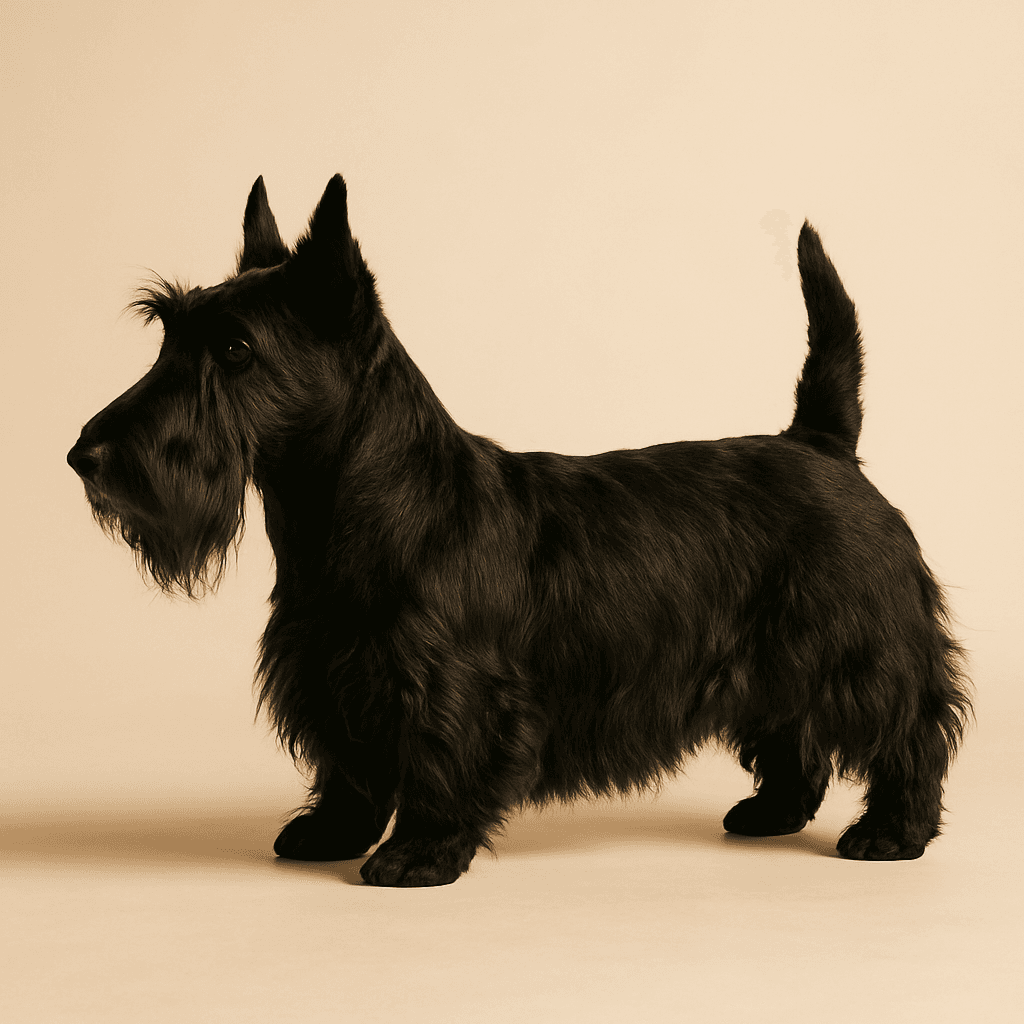
The Scottish Terrier, affectionately known as the Scottie, is one of Britain's most recognisable and beloved terrier breeds, a compact, low-slung and powerfully built earth dog developed in Scotland to hunt foxes, badgers and other quarry in the rocky, heathery terrain of the Scottish Highlands, working independently and with great determination in underground burrows and rocky outcroppings that required a dog of specific physical dimensions, considerable courage and genuine tenacity. The breed was formally standardised in the 1880s and quickly became popular both as a working terrier and as a show and companion dog, achieving international recognition and appearing as one of the tokens in Monopoly, as President Franklin D Roosevelt's companion Fala, and in numerous other cultural contexts that reflect its status as an iconic dog. It is registered by the Kennel Club in the Terrier Group. The Scottish Terrier is a small, compact and powerfully built dog of distinctive and immediately recognisable appearance. The coat is a hard, dense and wiry outer coat over a soft, dense undercoat, typically in black, wheaten or brindle. The long head is characterised by a profuse beard and eyebrows that give the breed its distinguished, somewhat stern expression. The body is longer than it is tall, the legs short but powerful, and the overall impression is of a determined and capable working terrier packed into a compact frame. Adults typically stand 25 to 28 centimetres at the shoulder and weigh 8 to 10 kilograms. The character is bold, dignified and independent - a terrier in the truest sense of the word, bred to make its own decisions underground and not given to ready compliance with instructions that contradict its own judgement. The Scottish Terrier is devoted to its own family and affectionate in the right context, but it is reserved with strangers and is not the instantly sociable, eager-to-please companion of some other small breeds. It is stubborn and persistent, which are virtues when working underground but require management in the home environment. Training requires patience, consistency and positive reinforcement established from an early age. Force produces resistance. The breed can achieve good behaviour when training is approached correctly but it will always retain its independent character. The primary health concerns are Scottie Cramp, Von Willebrand's Disease and a documented higher cancer incidence. Prospective owners should discuss cancer risk openly with any breeder. Purchase prices from KC-registered, health-tested breeders range from £700 to £1,500. Monthly running costs average £65 to £110. The Scottish Terrier Club is the primary resource for breed information, health testing requirements, responsible breeders and rescue contact.
Quick facts
Meet Our Scottish Terriers
Register your dog on My Dog and it will appear here automatically.
Scottish Terrier Photos
No photos yet. Be the first to share yours.
Add a photoActivity Feed
How much exercise does your Scottish Terrier really need each day?
At least 45 to 60 minutes daily, and don't be fooled by the size. Scotties have serious terrier stamina and drive packed into that compact frame. Mine is absolutely tireless on a walk and shows no sign of flagging long after I've started thinking about turning back. Recall is something I worked on extensively and I'm still careful in areas with wildlife, the prey drive is strong and it genuinely takes over when something interesting runs past. In areas with rabbits or squirrels, I keep him on a long line rather than fully off lead. Mental stimulation matters too, so I use training sessions and puzzle feeders to supplement the physical walks. Underestimating the exercise needs of a Scottie is one of the most common mistakes I see new owners make. They're small but they are not low-energy.
30 June 2026
Any health issues to watch for with Scottish Terriers?
There are a few important ones worth researching before you commit. Scottie Cramp is a neurological condition completely unique to the breed, it causes involuntary muscle spasms during or after exercise and can look alarming if you don't know what you're seeing. Von Willebrand's Disease, a bleeding disorder, is documented in the breed and DNA testing of parents is available, so ask breeders directly. The one that concerns me most for the breed is cancer risk, Scottish Terriers have a significantly higher documented incidence of certain cancers compared to the general dog population, particularly transitional cell carcinoma and bladder cancer. This isn't a reason not to get one, but it's information every prospective owner deserves to have honestly. I'd discuss it directly with any breeder and with your vet before buying. The Scottish Terrier Club is a good resource.
30 June 2026
What's the one thing you wish you'd known before getting a Scottish Terrier?
The stubbornness is not an exaggeration and it requires a specific response. I came from breeds where persistence in training eventually pays off in compliance. With my Scottie, persistence matters but patience and positive reinforcement are the only tools that actually work, any attempt at force or frustration produces pure, dignified resistance. He was bred to hunt underground without human direction, making his own decisions in tight, dark spaces. That independence isn't a training flaw; it's what he was built for. He is also one of the most devoted and loyal dogs I've ever known, deeply affectionate with those he trusts and utterly indifferent to those he doesn't. That reserved quality with strangers reads as aloofness but it's actually just dignity. Training from puppyhood, consistent positive methods, and a realistic acceptance of the terrier character, that's the formula.
30 June 2026
What do you feed your Scottish Terrier, and why?
A high-quality complete dry food for small active breeds, fed in two meals a day. The one practical challenge with Scotties is monitoring weight, because the dense, heavy coat is very good at concealing what's happening to their condition underneath. I do a hands-on check weekly, running my hands along the ribs, rather than relying on visual assessment alone. Mine has a good appetite and would eat more than he should if I let him, so I'm fairly strict with portions. Dental health is a priority too; small breeds are more prone to tartar build-up, so I use dental chews alongside his food and keep up with vet dental checks. Nothing complicated about the feeding side of Scotties. It's more about consistency and paying close attention to condition than anything exotic.
30 June 2026
Scottish Terrier of the Month
🏆 September 2026 -- Be the first nominee
Could be your dog.
The first dog registered in this community earns the first Dog of the Month nomination automatically.
Register your dogUpcoming Scottish Terrier Meetups
No meetups planned yet. Be the first to organise one.
Sign in to organise a meetupCommunity Members
Be the first to join and become the Scottish Terrier Founding Member.
Join Club