

Be the first to join. Keep the badge forever.
The first members of this community earn permanent Founding Member status. It shows on your profile and your dog's profile for as long as you're here.
- ✓Founding Member badge on your profile
- ✓Your dog featured first
- ✓First Dog of the Month nomination
- ✓Always free
⭐ Founding Member spots open
First to join gets the badge
🐕 Be the first dog registered
Add your Lab to the community
📷 Add the first photo
Start the photo wall
8
Discussions
0 members
8 discussions
About the Rottweiler
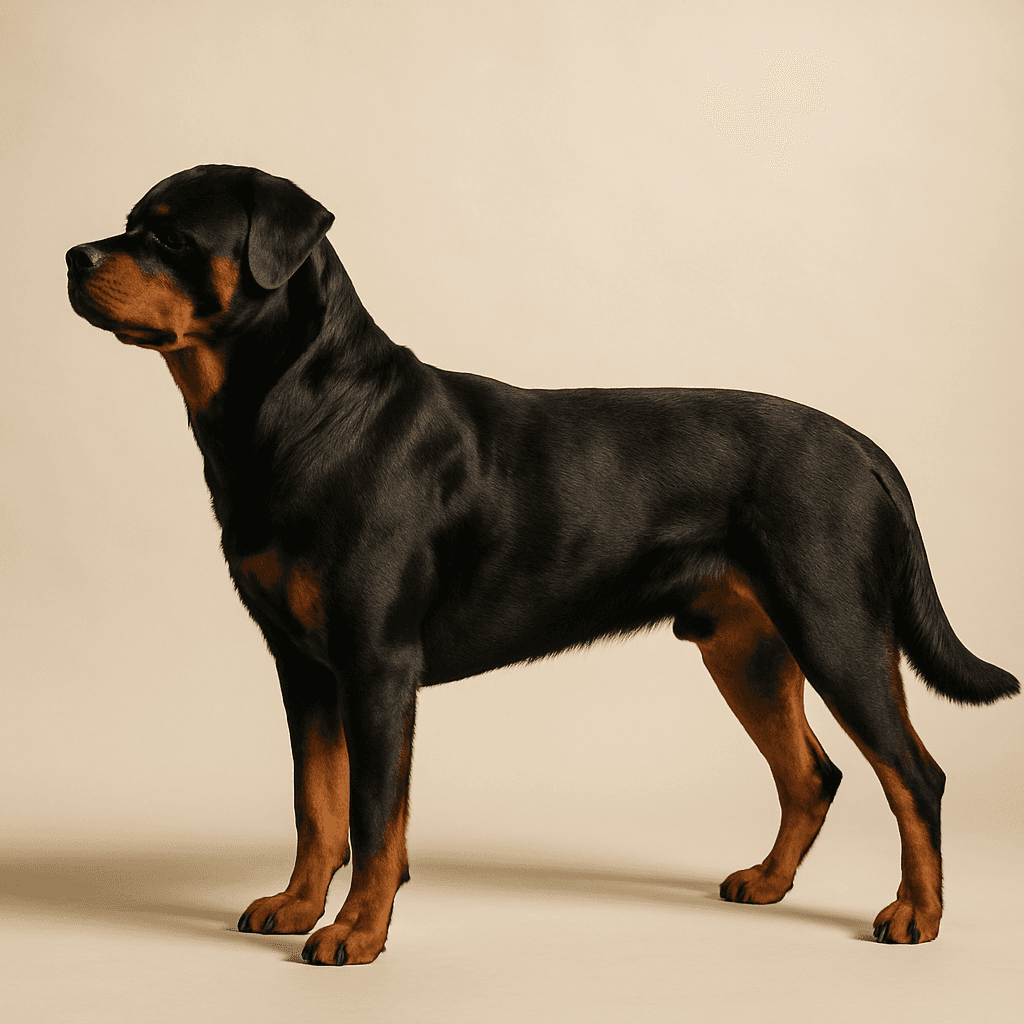
The Rottweiler is a large, powerful and highly capable working dog registered by the Kennel Club in the Working Group. It is one of the oldest herding and droving breeds in Europe, used by the Romans to drive cattle and later by German butchers in Rottweil to pull carts and guard livestock. That heritage is written into the breed's character: confident, calm when properly raised, deeply loyal to its family, and possessed of a natural guarding instinct that requires knowledgeable management. Rottweilers are not a breed for inexperienced owners. They are large, strong dogs with a dominant temperament that will test an owner who is uncertain, inconsistent or who does not establish clear leadership through calm, consistent positive training from puppyhood. A well-raised, well-socialised Rottweiler is a stable, affectionate and impressive companion. A poorly raised one, given inadequate socialisation and training, is a serious management problem. The difference is entirely determined by the owner's approach and commitment. Socialisation from puppyhood is non-negotiable. Rottweiler puppies must be exposed to a wide and varied range of people, environments, other animals and situations during the critical 8 to 16 week window. This does not dilute their guarding instinct: it produces a dog that can distinguish between genuine threat and normal daily life. An under-socialised Rottweiler that is reactive to everything is not a better guard dog; it is an unpredictable liability. Exercise requirements are substantial. Adult Rottweilers need at least one to two hours of structured exercise per day, combined with mental stimulation. They thrive with a job: obedience work, tracking, protection sports and weight pulling all suit the breed's physical capabilities and mental engagement needs. Health testing is essential when buying a Rottweiler puppy. The breed carries meaningful risks of hip dysplasia and elbow dysplasia, both assessed through the KC/BVA schemes, and sub-aortic stenosis (SAS), a congenital heart condition that should be screened for by a veterinary cardiologist before breeding. Ask to see hip scores, elbow grades and cardiac clearance on both parents. Rottweilers are not banned under the Dangerous Dogs Act 1991. They are subject to the general requirement that all dogs must be under control in public but are not listed breeds. Purchase prices from health-tested KC-registered breeders typically range from £1,000 to £2,000. Monthly insurance for a Rottweiler is high, typically £50 to £100, reflecting both the breed's size and the health risks. Lifespan is typically 8 to 10 years. Rottweiler Welfare UK is the primary breed-specific rescue and rehomes dogs nationally. The Rottweiler is a breed that rewards serious ownership with exceptional loyalty and companionship. Do the research, find a health-tested breeder, invest fully in training and socialisation, and this is one of the most rewarding dogs you can own.
Quick facts
Meet Our Rottweilers
Register your dog on My Dog and it will appear here automatically.
Rottweiler Photos
No photos yet. Be the first to share yours.
Add a photoActivity Feed
How much exercise does your Rottweiler really need each day?
Between 75 and 90 minutes for an adult, but structured exercise is what matters more than raw duration. A Rottweiler that's walked for an hour but has no mental engagement is far less settled than one that's had 45 minutes with some obedience work woven through it. Mine thrives on having a job: tracking games, obedience drills, carting if you're into that. What I'd stress to anyone new to the breed is puppy exercise rules. Growing joints in a large breed are vulnerable. I followed the five-minutes-per-month-of-age guideline strictly and avoided hard surfaces, jumping and sustained running until his growth plates had closed around 18 months. It felt cautious at the time but I'm glad I did it. Swimming is also excellent for them, especially in warm weather when dark-coated large dogs overheat more quickly than you'd expect.
30 June 2026
Any health issues to watch for with Rottweilers?
Several, and I'd want any prospective owner to know them going in rather than being surprised. Hip and elbow dysplasia rates are relatively high in the breed and both should be scored on the parents through the KC/BVA scheme. Sub-aortic stenosis is a congenital heart condition that ranges from mild to potentially causing sudden death in young adults, so cardiac screening by a veterinary cardiologist is part of the responsible breeding protocol. Osteosarcoma has a higher incidence in large breeds including Rottweilers than in smaller dogs. Hypothyroidism occurs in some lines. Monthly insurance for comprehensive lifetime cover typically runs £50 to £100, which tells you something about the risk profile. None of this should put you off a well-bred Rottweiler, but it does mean buying from a breeder who does the full health testing is not optional.
30 June 2026
What's the one thing you wish you'd known before getting a Rottweiler?
How much loose lead training would matter in the long term. It sounds mundane compared to the bigger questions around socialisation and temperament, but a pulling Rottweiler is a genuinely difficult physical management problem for most adults. I started with a harness and consistent loose lead work from the first day I brought him home, and I'm very glad I did. Mine is now a pleasure to walk. I've met Rottweilers who pull and their owners are visibly struggling, and correcting it once established is so much harder than building the habit correctly from day one. Beyond that, the socialisation window between 8 and 16 weeks is absolutely critical. The breed's natural guardian instinct needs thorough, positive early exposure to people, environments and other animals to develop appropriately. Don't underestimate either of these.
30 June 2026
What do you feed your Rottweiler, and why?
A high-quality large breed complete food, two meals a day, and I monitor weight consistently. The large breed formulation matters, particularly during puppyhood, because the calcium-phosphorus ratio is calibrated for appropriate bone development in a breed with documented hip and elbow dysplasia risk. I fed a large breed puppy formula until 18 months and then transitioned to adult. The two-meal approach is partly about bloat risk management in a large deep-chested dog. I avoid vigorous exercise for an hour either side of meals. Weight management is genuinely important with a Rottweiler because excess weight puts additional load on joints that may already be under strain from hereditary conditions. I can feel the ribs without pressing hard but they're not visible. I adjust portions if his activity level drops for any reason.
30 June 2026
Rottweiler of the Month
🏆 September 2026 -- Be the first nominee
Could be your dog.
The first dog registered in this community earns the first Dog of the Month nomination automatically.
Register your dogUpcoming Rottweiler Meetups
No meetups planned yet. Be the first to organise one.
Sign in to organise a meetupCommunity Members
Be the first to join and become the Rottweiler Founding Member.
Join Club