

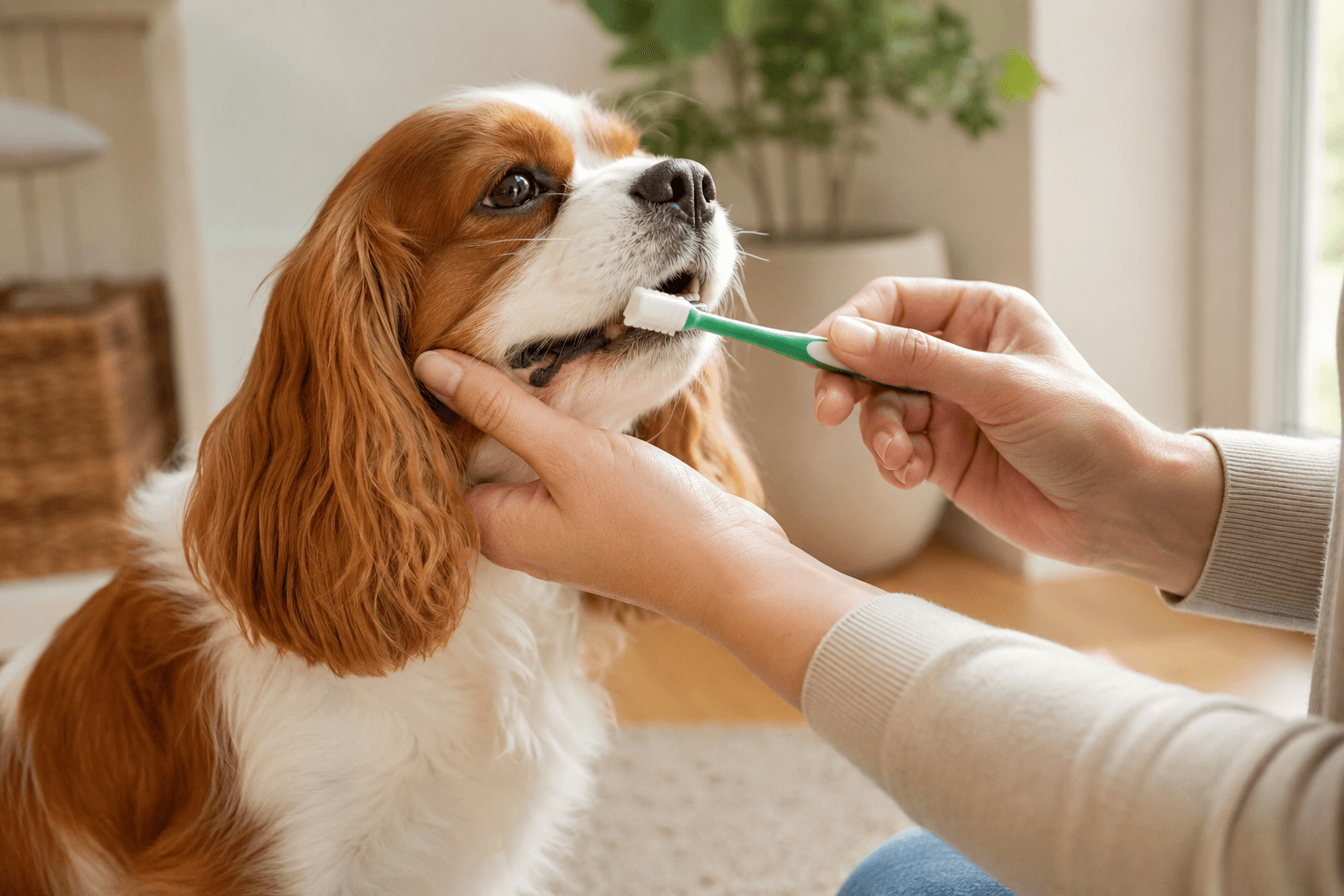
How to Clean Your Dog's Teeth: A Step-by-Step Guide
Quick answer
Start with your finger and a small amount of dog-safe toothpaste. Build up over one to two weeks. Focus on the outer surfaces of the back teeth. Aim for two minutes daily. Never use human toothpaste — xylitol is toxic to dogs.
What You Need
Toothbrush options
- Finger brush: rubber or silicone cap that fits over your index finger. Best for starting out and small breeds.
- Dual-headed dog toothbrush: longer handle, angled head to reach back teeth. Good for medium and large breeds once your dog is comfortable.
- Children's soft toothbrush: the RSPCA notes this is a reasonable substitute for medium and large dogs if a dog-specific brush is unavailable.
Toothpaste
Always use toothpaste specifically formulated for dogs. Human toothpaste is unsafe: it frequently contains xylitol, which is toxic to dogs, and fluoride at concentrations harmful if swallowed. If you are unsure whether a product is safe, check with your vet before using it.
The Introduction Phase: One to Two Weeks
Do not attempt to brush your dog's teeth on the first day. The introduction phase takes one to two weeks depending on your dog. Progress only when your dog is genuinely relaxed at each stage, not merely tolerant.
Step 1: Mouth handling
With your dog calm, gently stroke their cheek and muzzle. Do this for 30 seconds, then reward with praise and a treat. Repeat once or twice daily for two to three days until your dog shows no tension when you approach their face.
Step 2: Gum and lip contact
Gently lift your dog's lip on one side and lightly run a clean finger along the outer gumline. Reward immediately. You are working on outer surfaces only -- the inside can wait. Repeat over two to three days until your dog is fully relaxed.
Step 3: Introducing toothpaste
Put a small amount of dog toothpaste on your finger and let your dog lick it. Then try applying a small amount along the outer gumline with your finger. Reward well. Dogs who enjoy the flavour will actively seek the finger out -- that is the ideal response.
Logic Oral Hygiene Gel works particularly well at this stage as it can be used with or without brushing, and most dogs accept the taste readily.
Step 4: Introducing the brush
Let your dog sniff and lick the toothbrush. Add a small amount of toothpaste and let them lick it from the bristles. Once comfortable, begin gentle contact with the large canine teeth first -- not the incisors at the front, which are more sensitive.
Step 5: Progressing to full brushing
Once your dog accepts the brush on the canines, extend to the premolars and molars -- the back teeth are the highest priority. Keep sessions short initially. End every session with a reward.
If at any stage your dog shows stress, growling, or stiffening -- stop. Return to the previous stage and slow down. Forcing the process creates lasting resistance. If your dog is consistently resistant despite a gradual approach, ask your vet or a behaviourist for guidance.
The Brushing Technique
Positioning
Position yourself alongside your dog rather than facing them directly -- facing head-on can feel confrontational. Many owners find it easiest with the dog sitting next to them, head turned slightly to the side.
Technique
- Apply a pea-sized amount of toothpaste to the brush (less for small breeds).
- Hold the brush at a 45-degree angle to the tooth surface, angled toward the gumline where tooth meets gum -- this is where plaque accumulates most.
- Use gentle circular motions or short back-and-forth strokes. Do not scrub hard.
- Focus on the outer surfaces of the teeth. The tongue partially cleans the inner surfaces.
- Work from the back teeth forward. The back molars and premolars are hardest to reach and most important.
- Aim for roughly 30 seconds per side -- two minutes total.
- End every session with praise and a reward.
Common mistakes
- Brushing only the front teeth -- back molars are where tartar accumulates most severely
- Not brushing long enough -- two minutes of genuine contact is the target
- Pressing too hard -- the enzymes and bristle action do the work, not force
- Inconsistency -- a reliable three-times-a-week routine maintained for years beats a perfect daily routine that collapses after a month
Dogs Who Won't Accept Brushing
Option 1: Finger application of enzymatic toothpaste
Apply Logic Oral Hygiene Gel directly to your finger and rub along the outer teeth and gumline. This delivers enzymatic action without the sensation of a brush. Less mechanical cleaning than a toothbrush but still worthwhile.
Option 2: VOHC-approved dental chew daily
One VOHC-accepted dental chew per day provides meaningful mechanical cleaning, particularly on back teeth. The strongest alternative when brushing is genuinely not possible.
Option 3: ProDen PlaqueOff Powder
Sprinkled onto food daily, this VOHC-accepted seaweed supplement works systemically via saliva to reduce plaque and tartar adhesion. No contact with the mouth required. Not suitable for dogs with thyroid conditions.
If none of the above is achievable and your dog has not had a dental examination recently, speak to your vet. Dogs with existing dental disease may be in pain, and a professional clean under anaesthetic may resolve both the disease and the resistance to home care.
See our complete dog dental care guide for more on home dental care options and when to seek professional treatment.
Recommended toothpastes and kits
Logic
Logic Oral Hygiene Gel 70g
Enzymatic gel that works with or without brushing. Vet-recommended. Suitable from 3 months.
Buy on AmazonVirbac
Virbac CET Oral Hygiene Kit
Kit includes dual-headed toothbrush and enzymatic toothpaste. The vet-standard starter pack.
Buy on AmazonIf your dog won’t accept brushing
Whimzees by Wellness
Whimzees Brushzees Small 56-pack
VOHC-accepted. Plant-based, grain-free. Five sizes. Best all-round dental chew for most dogs.
Buy on AmazonPedigree
Pedigree Dentastix Medium
VOHC-accepted. Most affordable evidence-backed daily chew. Widely available. X-shape targets gumline.
Buy on AmazonGreenies
Greenies Original Regular
VOHC-accepted. Highly palatable poultry flavour. Six sizes. Long track record of VOHC testing.
Buy on AmazonProDen PlaqueOff
ProDen PlaqueOff Dental Bones
VOHC-accepted. Seaweed-based dental bone with multiple flavours. From the makers of PlaqueOff Powder.
Buy on AmazonAffiliate disclosure: This guide contains affiliate links. Woof & Woofer earns a commission if you purchase through these links, at no extra cost to you. This does not influence our recommendations -- we only feature products and providers we consider genuinely useful to UK dog owners. See our full affiliate disclosure policy.
Frequently Asked Questions
Daily is ideal -- plaque hardens into tartar within 24 to 48 hours. If daily is not achievable, three times per week is the minimum recommended frequency. On days you cannot brush, a VOHC-approved dental chew provides useful supplementary benefit.
Bleeding gums usually indicate gingivitis (early gum inflammation) rather than a reason to stop. Gentle brushing can help improve mild gingivitis over time. However, if bleeding is significant, persists after a week of gentle brushing, or is accompanied by swelling or pain, stop and consult your vet before continuing.
No. Dog toothpaste is formulated to be swallowed safely. Enzymatic toothpastes continue working in the mouth after brushing -- rinsing would reduce their effectiveness.
No. High sodium content can disrupt electrolyte balance and cause stomach upset. Its alkaline pH can also interfere with the natural oral environment. Use only enzymatic toothpaste formulated for dogs.
No, but check with your vet first. A dog who has never had dental care may have significant tartar build-up or periodontal disease, and brushing over diseased gums without treatment can be painful. A professional clean may be the right first step before establishing a home routine.
Yes. Daily brushing prevents plaque build-up and slows tartar formation significantly, but it cannot remove hardened tartar or clean below the gumline. Annual dental checks with your vet allow them to assess whether professional cleaning is needed and to catch emerging problems early.
More from Dog Health

How to keep your dog cool in the heat: tips every UK owner needs
Heatstroke can kill a dog in under an hour. Most UK vets advise avoiding walks above 25°C, particularly for flat-faced breeds, elderly dogs and overweight dogs. Do the five-second pavement test before every walk: press the back of your hand flat on the ground for five seconds. If you cannot hold it there, it is too hot for your dog's paws. If heatstroke is suspected, follow Cool First Transport Second: apply cool water to the belly, armpits and paws, call your vet, then transport.
Read guide →
Dog Insurance UK: The Complete Guide to Choosing the Right Cover
The average UK dog insurance claim is £685, and complex treatments regularly exceed £4,000. Lifetime cover is the most comprehensive policy type, resetting your vet fee limit every year so long-term conditions stay covered for life. Dog insurance in the UK costs between £15 and £120 per month, depending on your dog's breed, age, policy type, and where you live.
Read guide →
Dog Vaccinations UK: Core Vaccines, Boosters and Costs
Adult dogs in the UK need annual leptospirosis boosters and three-yearly boosters for distemper, hepatitis and parvovirus, unless titre testing confirms existing immunity. The BVA supports titre testing as an alternative to automatic three-yearly core boosters, but annual leptospirosis vaccination should continue regardless.
Read guide →