Labradoodle vs Goldendoodle: Which Should You Choose?
Quick answer
Labradoodles and Goldendoodles are near-identical in coat, cost and grooming demands. Choose a Labradoodle for a driven, water-loving, retrieval-oriented dog with a slightly more predictable size; choose a Goldendoodle for a gentler, more affectionate temperament, accepting a longer health-testing checklist for cardiac risk (SAS) and elevated cancer risk from the Golden Retriever side.
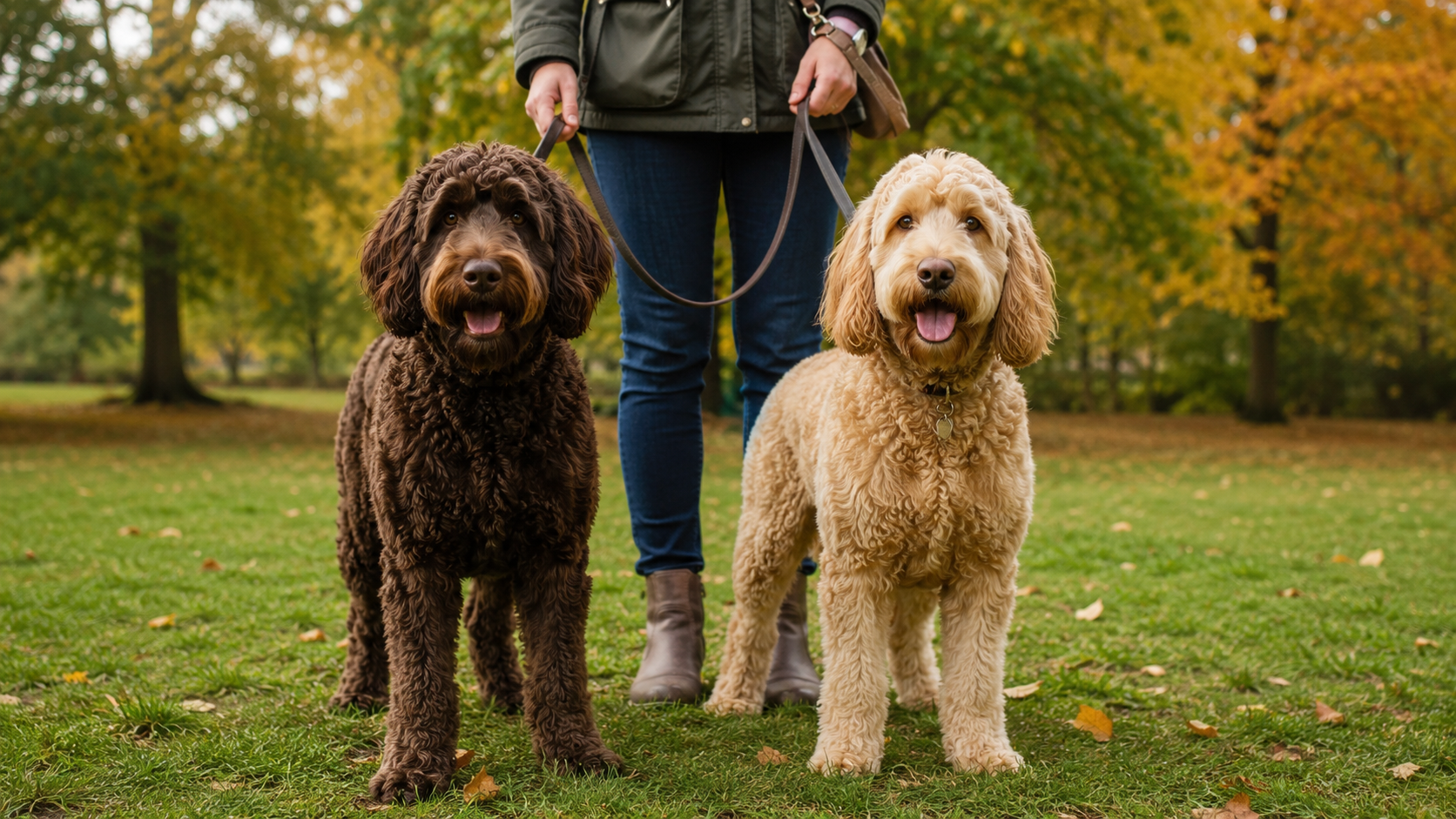
The Labradoodle and the Goldendoodle are two of the most popular doodle crosses in the UK. Both are Poodle-based crossbreeds with similar coats, similar prices, and similar energy levels. On the surface they look nearly identical. But the non-Poodle parent makes a meaningful difference, and that difference will shape your day-to-day experience of living with the dog.
This guide sets them side by side across temperament, health, costs and suitability so you can make a clear decision rather than choosing by coat colour.
At a Glance
| Labradoodle | Goldendoodle | |
|---|---|---|
| Parent breeds | Labrador Retriever x Poodle | Golden Retriever x Poodle |
| Weight (standard) | 23-30 kg | 20-35 kg |
| Lifespan | 12-14 years | 10-15 years |
| Exercise (adult) | 90-120 mins/day | 60-90 mins/day |
| Activity level | High | High |
| Grooming | High | High |
| Good for first timers | Yes | Yes |
| Suits flats | No | No |
| Good with children | Yes | Yes |
| Monthly running cost | £140-£265/month | £120-£190/month |
| Purchase price | £1,500-£3,500 | £1,500-£3,500 |
| Insurance (monthly) | £50-£90 | £40-£80 |
| KC registered | No | No |
| Origin | Australia, 1980s | USA, 1990s |
Temperament: Enthusiastic vs Affectionate
Both breeds are sociable, people-oriented, and good with children and other dogs. The difference is in the underlying energy.
Labradoodle temperament
The Labrador parent brings boisterous, enthusiastic energy that matures slowly. Labrador-leaning Labradoodles are exuberant, can be strong pullers as puppies, and are harder to manage indoors if under-exercised. This settles with training and age, but expect a high-energy dog through the first few years.
They are eager to please and food-motivated, which makes training highly effective when started early. They love to retrieve, swim, and work alongside their owners.
Goldendoodle temperament
The Golden Retriever parent brings a slightly gentler, warmer character. Goldendoodles tend to be affectionate and softer in nature compared to their Labradoodle counterparts, though the difference is not dramatic. Both are active dogs that need daily meaningful exercise.
Like Labradoodles, Goldendoodles bond closely with their families and can develop separation anxiety if not taught independence from puppyhood.
Individual variation
In any F1 cross, the temperament balance between parent breeds is unpredictable. One Labradoodle may lean strongly Labrador; another may be much more Poodle-like. The same applies to Goldendoodles. Generation matters: F1b dogs (backcrossed to Poodle) tend toward Poodle traits.
Verdict: Both are excellent family companions. If you want slightly calmer and more cuddly, lean Goldendoodle. If you want a driven, water-loving retrieval-oriented dog, lean Labradoodle. The gap is smaller than most people expect.
Exercise: Who Needs More?
On paper, both breeds share a 60-90 minute daily exercise quick-stat. In practice, Labradoodles typically need more. The Labradoodle breed guide recommends 90 minutes to two hours per day for a standard adult. Under-exercised Labradoodles are noticeably harder to live with.
Goldendoodles are active dogs too, but the Golden Retriever parent is slightly less driven. Standard Goldendoodles need one to two hours; miniature Goldendoodles can manage 45-60 minutes.
Both breeds love water. Both benefit from retrieve games, scent work, and off-lead exercise. Neither suits a sedentary household.
Puppy exercise: follow the five minutes per month of age guideline for both breeds. Given both carry hip and elbow dysplasia risk, avoid repetitive high-impact exercise on hard surfaces until skeletal maturity at around 18 months.
Verdict: Slight edge to Goldendoodle for exercise requirements, but the difference is marginal for standard-sized dogs. Both need committed, active owners.
Coat and Grooming: Equally Demanding
This is where these two breeds are most similar.
Both inherit coat variability from the F1 cross. Some individuals are curly and low-shedding; others are wavy with moderate shedding; some are straighter and shed more noticeably. Coat type cannot be predicted reliably at birth, particularly in F1 crosses.
Neither breed is reliably non-shedding or hypoallergenic. The allergen that affects humans is Can f 1, present in saliva and skin, not the coat itself. For more detail, see are doodles and crossbreeds really hypoallergenic?
Professional grooming requirements are essentially identical: every six to twelve weeks at £55-£90 per session for a standard-sized dog, plus brushing two to three times per week at home.
One minor practical difference: Golden Retriever coat genes can produce slightly higher shedding in some Goldendoodles with straighter coats. This is not consistent enough to be a decisive factor in your choice.
Verdict: This is a draw. Both require the same grooming commitment and budget. If coat type is critical, ask to see both parents and understand what generation the puppy is before committing.
Health and Health Testing
This is the most important section and the one where the two breeds differ most meaningfully.
Shared health risks
Both Labradoodles and Goldendoodles inherit hip and elbow dysplasia risk from their non-Poodle parent, and Progressive Retinal Atrophy (PRA) risk from the Poodle side. Both require this core health screening from both parents:
- BVA/KC Hip Score
- BVA/KC Elbow Grade
- prcd-PRA DNA test (Poodle parent)
Labradoodle-specific health tests
The Labrador parent carries additional DNA-testable conditions:
- Exercise-Induced Collapse (EIC): DNA test. Affects Labradors. The parent should be Clear or paired Clear-to-Carrier.
- Centronuclear Myopathy (CNM): DNA test. A Labrador-specific muscle condition. Ask for results.
- PRA (Labrador form): Labradors carry their own PRA form separate from the Poodle form. Both parents should be tested.
Goldendoodle-specific health tests
The Golden Retriever parent carries different conditions:
- Subvalvular Aortic Stenosis (SAS): A heart condition. The Golden Retriever parent should be cardiac screened by a cardiologist.
- Ichthyosis: A skin condition causing flaky, thickened skin. A DNA test is available; the Golden Retriever parent should be tested.
Cancer risk
Golden Retrievers have among the highest cancer rates of any dog breed. Goldendoodles may inherit some of this elevated risk. The data for first-generation crosses is less established than for pedigrees, but it is a real factor to discuss with your vet before committing.
Labrador Retrievers carry cancer risk too, but it is not as prominently elevated as in Golden Retrievers. If longevity and cancer risk are significant factors, this is worth weighing carefully.
Ear infections
Both breeds are prone to ear infections. The combination of hanging ear flaps and dense, potentially hair-filled ear canals creates conditions for moisture retention and chronic infection. Weekly ear checking and cleaning is essential for both.
Verdict: The Labradoodle has a longer health testing checklist (EIC, CNM on top of core tests). The Goldendoodle introduces cardiac risk and elevated cancer risk from the Golden Retriever side. Neither is healthier in absolute terms. In both cases: never buy from a breeder who cannot provide documented health test results.
Crossbreed health testing: what to ask your breederCosts
The two breeds are broadly similar in cost, with some nuances.
Monthly running costs comparison
| Labradoodle | Goldendoodle | |
|---|---|---|
| Food | £40-£90/month | £35-£65/month |
| Insurance | £50-£90/month | £40-£80/month |
| Grooming (avg) | £30-£50/month | £30-£50/month |
| Vet & parasites | £20-£35/month | £20-£35/month |
| Total estimate | £140-£265/month | £120-£190/month |
The Labradoodle sits slightly higher in insurance cost, reflecting size. Both breeds are expensive to insure; lifetime policies are essential for ongoing conditions. Purchase prices are equivalent at £1,500-£3,500 from reputable health-tested breeders.
Verdict: Very similar costs overall. Budget for either and you will be in the right range. Labradoodle insurance runs marginally higher.
Who Should Choose Which?
Choose a Labradoodle if:
- You want a dog with strong retrieval drive and outdoor working energy
- You are comfortable with a more boisterous, exuberant dog through puppyhood and adolescence
- You want slightly more predictable size (23-30 kg vs up to 35 kg for standard Goldendoodle)
- You can commit to the Labrador-specific testing checklist (EIC and CNM on top of core tests)
- You are drawn to the original crossbreed purpose: a guide dog candidate with a lower-shedding coat
Choose a Goldendoodle if:
- You want a slightly softer, gentler energy day-to-day
- You prefer the Golden Retriever warmth and sociability as the base character
- You are comfortable with cardiac screening (SAS) as an additional health test requirement
- You understand and accept the elevated cancer risk and will choose a well-screened puppy accordingly
- You are drawn to a slightly more cuddly family companion over a driven working-type dog
Neither is right for you if:
- You want a low-maintenance coat. Both require significant ongoing professional grooming.
- You want a KC-registered breed with a formal health scheme. Neither is eligible.
- You believe either breed is reliably hypoallergenic. They are not.
- You live in a flat with no outdoor access. Neither breed suits flat living.
- You are choosing based on appearance without verifying health testing. Walk away from any breeder who cannot provide documented results.
Rescue option: Both Doodle Trust and DoodleAid rehome Labradoodles and Goldendoodles across the UK. A rescue assessment gives you far more information about an actual adult dog than buying a puppy does about how it will turn out.
Frequently Asked Questions
Is a Labradoodle or Goldendoodle better for families with young children?
Both are typically good with children when well-socialised. The Goldendoodle may be slightly gentler in energy, which some families with toddlers prefer. A Labrador-leaning Labradoodle is more boisterous and can physically overwhelm very young children without consistent training. Either breed works well with children given proper obedience training from puppyhood.
Which breed sheds less: Labradoodle or Goldendoodle?
Neither is reliably low-shedding. Shedding depends on coat type, which is not predictable in F1 crosses of either breed. F1b dogs (backcrossed to Poodle) shed less in most cases. Golden Retriever coat genes can produce slightly higher shedding in some Goldendoodles with straighter coats, but this is not consistent. Do not choose either breed on the assumption you will get a non-shedding dog.
Do Labradoodles or Goldendoodles live longer?
Labradoodles have a typical lifespan of 12 to 14 years. Goldendoodles range from 10 to 15 years, with larger standard dogs toward the lower end. Both are comparable. Labrador Retrievers are on average slightly longer-lived than Golden Retrievers.
Which breed has fewer health problems?
Neither is categorically healthier. Both carry hip dysplasia, elbow dysplasia, and PRA risk. The Labradoodle adds EIC and CNM from the Labrador side. The Goldendoodle adds cardiac risk (SAS) and elevated cancer risk from the Golden Retriever side. Health outcome depends primarily on the quality of parental health testing, not the breed choice.
Are Goldendoodles more expensive than Labradoodles?
Purchase prices are similar: £1,500 to £3,500 for either from reputable health-tested breeders. Monthly running costs are comparable; Labradoodles may insure slightly higher due to size. Neither breed is a budget choice at any stage of ownership.
Can I use a quiz to decide between a Labradoodle and a Goldendoodle?
Yes. Our breed selector covers both breeds and factors in your lifestyle, household, and exercise capacity to give a personalised recommendation.
Want a more personalised recommendation? Take the breed selector quiz.