
How to find a responsible crossbreed breeder in the UK
Quick answer
A responsible crossbreed breeder health tests both parent dogs, lets you see the mother with the pups, provides a written contract, and will take the dog back if your circumstances change. If a breeder cannot tick all four of those boxes, keep looking.
This guide covers what to check, what to ask, and what to walk away from.
What does a responsible crossbreed breeder actually look like?
Crossbreeds are not registered by the Kennel Club, which means there is no single governing body setting enforceable standards. That puts more responsibility on you as a buyer.
A responsible crossbreed breeder will:
- Hold a current dog breeding licence from their local council (required if they breed three or more litters per year, and potentially required for fewer if they advertise puppies for sale as a business)
- Health test both parent dogs against the conditions relevant to their breeds
- Raise pups in a home environment, not a barn or kennel block
- Let you visit more than once before the pups go home
- Ask you questions — a breeder who does not ask about your home, experience, and lifestyle is not a breeder who cares what happens to the dog
- Keep pups with their mother until at least eight weeks old (a legal minimum in England; equivalent rules apply in Scotland and Wales)
- Be reachable after the sale
The honest caveat:
What health tests should crossbreed parents have?
Because crossbreeds inherit conditions from both parent breeds, both parents need testing — not just one.
The tests required depend on the cross. These are the most common:
Cockapoo (Cocker Spaniel x Poodle)
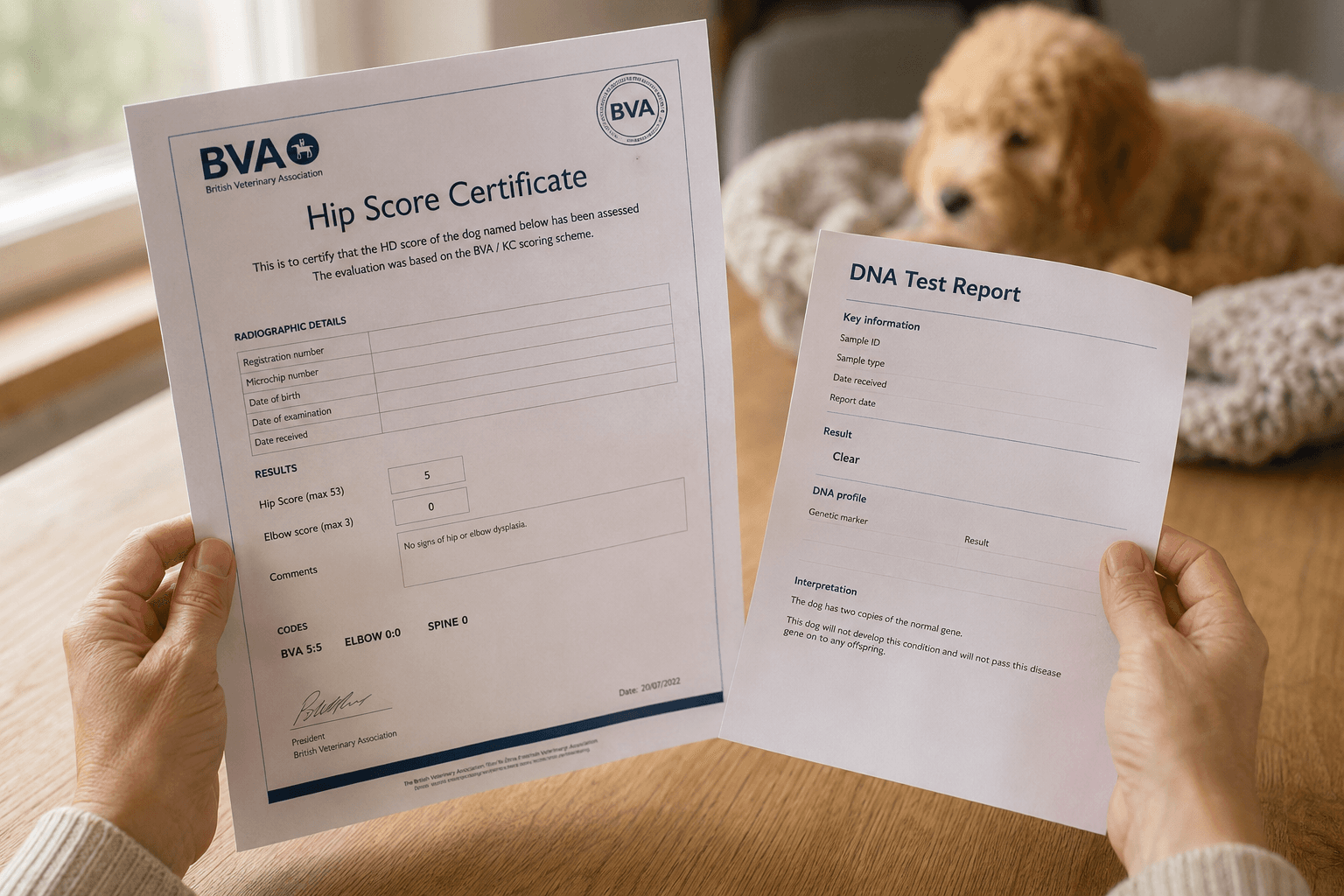
The Cocker Spaniel parent should have clear DNA results for prcd-PRA (a form of progressive blindness) and FN (familial nephropathy, a kidney condition that causes renal failure between six months and two years of age in affected dogs). BVA hip scoring is also recommended. The Poodle parent should have DNA testing for PRA and von Willebrand’s disease, plus BVA hip scoring and a current BVA eye test.
Labradoodle (Labrador x Poodle)
The Labrador parent should have BVA hip and elbow scores and a current BVA eye test. The Poodle parent should have PRA DNA testing, vWD testing, BVA hip scoring, and a BVA eye test. Both parents should have elbow scores if the Labrador side has a history of elbow problems.
Cavapoo (Cavalier King Charles Spaniel x Poodle)
The Cavalier parent must have BVA/KC heart testing (Cavaliers are at high risk of mitral valve disease), a BVA eye test, and ideally MRI scoring for syringomyelia. This is the one crossbreed where skipping parental heart and neurological screening is genuinely risky.
Goldendoodle (Golden Retriever x Poodle)
The Golden Retriever parent should have BVA hip and elbow scores and a BVA eye test. The Poodle parent requires PRA DNA testing, vWD testing, and BVA hip scoring.
A breeder who says their dogs are ‘naturally healthy’ or ‘crossbreeds don’t need testing’ has misunderstood genetics. Crossbreeds inherit the same conditions as their parent breeds; they simply inherit from two gene pools rather than one.
Ask to see the actual certificates, not just photos of them. Results should come from BVA schemes, the Kennel Club’s health testing programme, or accredited DNA testing laboratories. The BVA’s Canine Health Schemes lists every approved scheme.
Questions to ask a crossbreed breeder before you put a deposit down
Go in prepared. These are not difficult questions for a good breeder — they will answer them without hesitation.
About the health tests:
- Can I see the DNA test certificates and BVA score sheets for both parents?
- What were the hip scores? (For context: the BVA breed mean score is the benchmark — lower is better)
- Are the parents clear, carrier, or affected on the DNA tests?
About the parents:
- Can I meet the mother in person? Can I see her interacting with the pups?
- How old is the mother, and how many litters has she had? (A female should not be bred more than three times in her lifetime under current regulations)
- Who is the father, and can I see his health certificates?
About the breeding:
- How long have you been breeding this cross?
- Do you breed any other types of dogs?
- Are the pups raised in the house?
About the purchase:
- Do you provide a written puppy contract?
- What happens if I can no longer keep the dog?
- Can I visit more than once before picking up the pup?
If a breeder resists any of these questions or becomes defensive, that tells you what you need to know.

Red flags you should not ignore
These are not minor concerns. Any one of them is a reason to walk away.
- You cannot meet the mother in person, or she is described as ‘away’ or ‘at the vet’
- Multiple breeds or crosses are available at the same time
- Pups are available immediately, with no waiting list
- The breeder offers to deliver or meet you halfway
- Health test results are described verbally but you cannot see certificates
- Pressure to pay a deposit before you have visited
- The price is significantly below market rate for that cross
- The breeder does not ask you a single question about your situation
- Pups are in a shed, garage, barn, or commercial kennel
Many of these are indicators of a puppy farm or a puppy dealer operating in breach of Lucy’s Law.
How Lucy’s Law protects you
Lucy’s Law came into force in England on 6 April 2020. It bans the sale of puppies by third parties — including pet shops, dealers, and online brokers — to members of the public. You can only buy a puppy directly from its breeder, or rehome from a rescue centre.
In practice, this means:
- The person who bred the litter must be present at the sale
- The puppy must be shown with its mother at the premises where it was born and raised
- Any seller who does not meet these requirements is operating illegally
If a ‘breeder’ offers to meet you in a car park, deliver to your home, or has the pup available to collect immediately from a location you were not shown beforehand, they are almost certainly a dealer, not a breeder. Do not proceed.
Lucy’s Law applies in England, Wales, and Scotland. Northern Ireland does not yet have equivalent legislation in force, though it is expected to follow. Check the GOV.UK guidance on Lucy’s Law for current rules.

Does the Kennel Club Assured Breeder Scheme cover crossbreeds?
Yes, crossbreed breeders are eligible to join the Kennel Club’s Assured Breeder Scheme (ABS), provided they meet the scheme’s welfare and health testing requirements. The ABS currently has over 7,000 members and requires health screening on all breeding stock.
It is not a guarantee of quality — membership does not mean every pup from that breeder will be healthy — but it does mean the breeder has agreed to a set of enforceable standards and can be removed from the scheme for non-compliance.
You can search for Kennel Club Assured Breeders at thekennelclub.org.uk. Not every responsible crossbreed breeder will be on the list, but all breeders on the list have committed to minimum standards. Champdogs, the breed and breeder directory, also restricts listings to dogs with full health testing, making it a useful starting point for finding health-tested crossbreed breeders.
What a puppy contract must include
A written puppy contract is not a legal requirement in the UK, but it is a basic expectation from any serious breeder. If a breeder does not offer one, ask for it in writing.
A contract should cover:
- The full details of the breeder and buyer (name, address, contact information)
- Details of the puppy (sex, date of birth, colour, microchip number)
- Health test results for both parents, or reference to certificates provided
- Confirmation that the puppy has been vaccinated, microchipped, and vet-checked before sale
- A clause stating the breeder will take the dog back if you can no longer keep it
- The sale price and confirmation of payment
- Any breeding restrictions (common with crossbreeds, where the breeder may require pups not to be bred from)
The Puppy Contract, developed by the RSPCA and endorsed by the British Veterinary Association, is a free, standardised template that covers all the above. Ask your breeder to use it if they do not have their own.
Both parties should sign and keep a copy.
How much should you pay for a crossbreed puppy?
Prices for popular crossbreeds in the UK have risen sharply since 2020. As of 2025, typical ranges are:
- Cockapoo: £800 to £1,200 on average, with well-health-tested litters in high-demand areas reaching £1,500
- Labradoodle: £900 to £1,500 from licensed or reputable UK breeders
- Cavapoo: £1,000 to £1,800
- Goldendoodle: £1,200 to £2,000
A puppy offered significantly below these ranges should be treated with caution — either the parents have not been health tested, the welfare conditions are poor, or the seller is not the original breeder.
A price above these ranges is not automatically a sign of quality. Some breeders charge a premium for rare colours or ‘mini’ sizes without additional health testing to justify the cost.
Health testing adds genuine cost. DNA tests, BVA scheme assessments, hip scoring, and eye testing across two parent dogs can add several hundred pounds to the cost of producing a litter responsibly. A breeder charging £700 for a Cockapoo cannot also have spent £400 to £600 on parental health tests.
Frequently asked questions
Do crossbreed breeders need a licence?
In England, a licence from the local council is required if a breeder produces three or more litters in a 12-month period and sells any of the puppies. Breeders producing fewer litters may also need a licence if they advertise as a business. Operating without the required licence carries a penalty of an unlimited fine or up to six months in prison. You can ask to see a breeder's licence number and verify it with the issuing council.
Can I buy a crossbreed puppy online?
You can find breeders online, but the sale itself must happen in person with the puppy present and the mother available to see, as required under Lucy's Law. Paying a deposit online before visiting is not prohibited, but meeting the pup and mother before committing any money is strongly advisable.
What is the difference between a first generation (F1) and a second generation (F2) crossbreed?
F1 means both parents are purebred dogs from different breeds. F2 means both parents are themselves crossbreeds from the same pairing. Generation affects coat type, size, and trait predictability but does not automatically make one generation healthier than another. Health testing the parents remains important regardless of generation. See our guide to F1, F2 and F1b generations explained.
Should crossbreed puppies come with health certificates?
The puppy itself should have a vet-check certificate, vaccination records, and a microchip implantation certificate. These cover the puppy's own health at point of sale. The health certificates that matter most are the test results for the parent dogs. Ask for both.
What if something goes wrong after I bring the puppy home?
A written contract should include provisions for this. Under the Consumer Rights Act 2015, a puppy purchased from a trader (someone who sells as a business) is treated as goods; if the puppy has a health condition that was present at point of sale, you have legal recourse. If you bought from a private individual, your rights are more limited, which is another reason to buy from a licensed breeder with a contract in place.
Is it safe to import a crossbreed puppy from abroad?
The Animal Welfare (Import of Dogs, Cats and Ferrets) Act, which received Royal Assent in December 2025, raises the minimum import age for puppies to six months. At time of writing, implementation is subject to secondary legislation, so the exact date this comes into force has not been confirmed. Regardless of the legal minimum, imported puppies carry a higher risk of disease exposure and socialisation gaps. Buying from a UK-based breeder who you can visit in person is always the lower-risk option.