

Your Puppy's First Night Home: What to Expect
Quick answer
A puppy's first night home will usually involve some crying as they adjust to being away from their mother and littermates. Place the crate in your bedroom, take a toilet trip immediately before bed, and respond calmly overnight rather than leaving them to cry. Most puppies settle significantly within 3 to 7 nights.
Your Puppy's First Night Home: What to Expect
Your puppy's first night home will almost certainly involve some crying. This is normal, it does not mean you have done anything wrong, and it will pass. Understanding what your puppy is experiencing and setting up their sleep space correctly makes a significant difference to how quickly they settle.
What Your Puppy Is Going Through
Your puppy has spent every night of their life in a warm pile of littermates, with their mother nearby. Tonight, for the first time, they are completely alone. The crying is not manipulation: it is a genuine distress response to an unfamiliar and isolating situation.
The Blue Cross advises new owners to be realistic about the first few nights and to have a plan in place rather than making reactive decisions at 2am when sleep-deprived.
Setting Up the Sleep Space
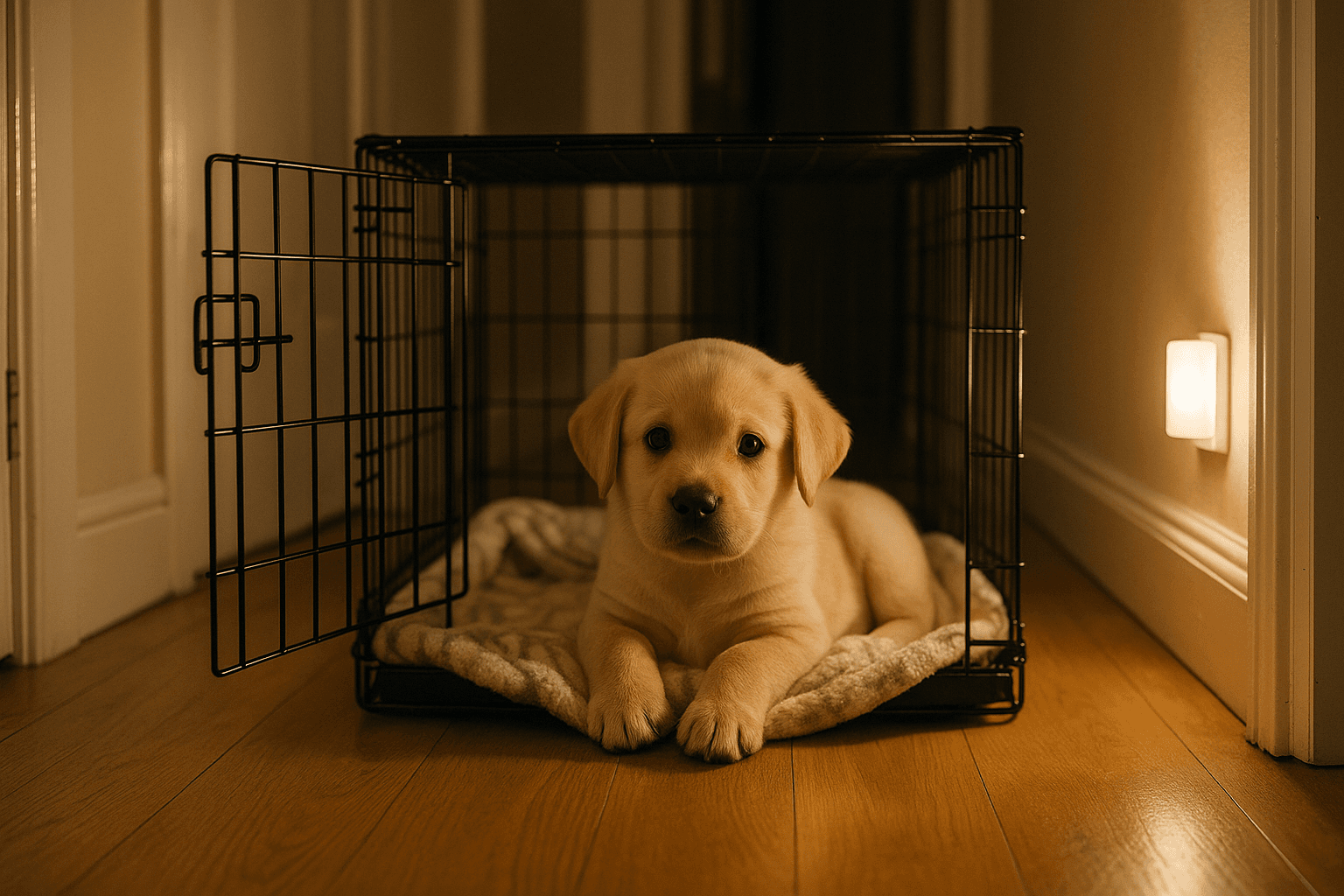
Crate or pen: A crate is the most practical sleep setup for a puppy. It should be large enough for your puppy to stand up, turn around and lie down, but not so large that they can toilet in one corner and sleep in another. Cover three sides with a blanket to create a den-like environment.
Place the crate in your bedroom for the first few weeks. This is the single most effective way to reduce first-night distress: your puppy can hear and smell you without being in your bed. It also makes night-time toilet trips faster and quieter.
Bedding: Ask the breeder for a piece of bedding or a toy that smells of the litter. This familiar scent is genuinely calming. Place it in the crate from the first night.
A covered warm water bottle wrapped in a towel can simulate littermate warmth. A ticking clock near the crate replicates a heartbeat. Both are small measures that can make a real difference on the first few nights.
Avoid:
- Putting the crate in an isolated room away from people
- Leaving the television or radio on all night (intermittent noise is more disturbing than silence)
- Letting your puppy sleep in your bed if you do not intend this to be the long-term arrangement
The First Night Routine
Establish the routine from night one. Consistency is what makes nights shorter:
- Last meal no later than 6pm to reduce overnight toileting need
- Last toilet trip immediately before bed: stay outside until your puppy performs
- Place your puppy in the crate with a chew or Kong stuffed with soft food
- Settle yourself nearby without making a fuss
- If your puppy cries, wait briefly before responding: a short wait teaches that crying does not produce immediate attention, but do respond, particularly in the first nights
If your puppy wakes in the night and cries, take them straight outside for a toilet trip with minimal interaction: no play, no lights on beyond what is needed, back into the crate immediately after. Most puppies at 8 to 12 weeks need one to two toilet trips overnight.
Toilet Training From Night One
Start as you mean to go on. The rule is simple: every time your puppy wakes, take them outside before anything else. Every time they go outside successfully, praise immediately and calmly.
Expect accidents indoors for several weeks. Young puppies cannot physically hold their bladder for more than 1 to 2 hours. At 8 weeks, full overnight bladder control is not realistic. By 12 to 16 weeks, most puppies can manage 4 to 5 hours. By 6 months, most can sleep through.
Never punish an accident. A puppy has no ability to connect punishment after the fact with the behaviour. Clean up with an enzymatic cleaner to remove the scent thoroughly and prevent the spot becoming a repeat toilet area.
The 3-3-3 Rule: Realistic Expectations
The 3-3-3 rule is a widely used framework for puppy and rescue dog settling:
- 3 days: Your puppy is decompressing. They may be overwhelmed, quiet, or conversely, hyperactive. Do not judge their personality yet.
- 3 weeks: Your puppy is learning the routine. They know when meals are, roughly where the toilet is, and who lives in the house.
- 3 months: Your puppy feels genuinely at home and their true personality is emerging.
Do not expect a settled puppy in week one. Do not worry if week one is hard.
Breed-Specific Notes
Flat-faced breeds (French Bulldogs, Pugs, Bulldogs): monitor overnight breathing. Brachycephalic puppies can develop respiratory distress. Ensure the sleep space is cool and well-ventilated. If you hear laboured or very noisy breathing beyond the typical snuffling, contact your vet.
Independent breeds (Basset Hounds, Shiba Inus, many sighthounds): may take longer to settle into a crate and may vocalise more persistently. Patience and consistency matter more than technique with these dogs.
High-anxiety breeds (Border Collies, German Shepherds, Vizslas): are more susceptible to separation-related problems if isolated from the start. Having the crate in your bedroom is particularly important for these breeds.
Small breeds (Chihuahuas, Toy Poodles, Miniature Dachshunds): are more vulnerable to hypoglycaemia (low blood sugar). Ensure regular overnight feeding in very young small-breed puppies: ask your vet for specific guidance.
When to Be Concerned
Most overnight settling issues are normal. Contact your vet if your puppy:
- Is not eating or drinking by the end of day two
- Has persistent vomiting or diarrhoea
- Is completely listless and unresponsive to gentle interaction
- Is breathing with obvious difficulty
For guidance on what comes next, see our New Puppy Guide covering the first weeks in full, or our Dog Training Hub for starting recall and basic commands from day one.
Frequently Asked Questions
Should I let my puppy cry it out on the first night?
Not entirely. Leaving a puppy to cry without any response can increase distress and damage your early relationship. A middle ground works best: wait a short period (a few minutes) before responding, then respond calmly with a toilet trip. Avoid reinforcing crying with excited attention or play.
Where should my puppy sleep on the first night?
In a crate in your bedroom. This is the setup most likely to result in a calm first night and the fastest transition to sleeping through. If you intend for your dog to sleep downstairs long-term, move the crate gradually over several weeks rather than starting there.
Is it OK to let my puppy sleep in the bed?
That is your decision. The main consideration is consistency: if you do not want a full-grown dog in your bed, do not start the habit as a puppy. If you are happy with it long-term, it is not harmful to the dog's behaviour or wellbeing.
How long will the crying last?
Most puppies significantly improve within 3 to 7 nights with a consistent approach. Some settle faster, some take two weeks. If crying is severe and shows no improvement after two weeks, consult a vet to rule out any underlying anxiety or health issue.
My puppy won't go into the crate. What do I do?
Do not force them in. Spend a few days feeding meals at the crate entrance, then inside with the door open, then inside with the door closed briefly. Build up gradually. A crate should be a positive space, not a place of confinement used as punishment.
How often does an 8-week-old puppy need a toilet trip overnight?
Every 2 to 3 hours is realistic for a very young puppy. Set an alarm rather than waiting for crying: proactive trips prevent accidents and help your puppy learn the outdoor toilet habit faster.
Frequently Asked Questions
Not entirely. Leaving a puppy to cry without any response can increase distress and damage your early relationship. Wait a short period before responding calmly with a toilet trip. Avoid reinforcing crying with excited attention or play.
In a crate in your bedroom. This is the setup most likely to result in a calm first night. Your puppy can hear and smell you without being in your bed. Move the crate to its long-term location gradually over several weeks once they are settled.
That is your decision. The main consideration is consistency: if you do not want a full-grown dog in your bed, do not start the habit as a puppy. If you are comfortable with it long-term, it is not harmful to the dog's behaviour or wellbeing.
Most puppies improve significantly within 3 to 7 nights with a consistent approach. Some settle faster, some take two weeks. If crying is severe and shows no improvement after two weeks, consult a vet to rule out underlying anxiety.
Do not force them. Spend a few days feeding meals at the crate entrance, then inside with the door open, then closed briefly. Build up gradually. A crate should be a positive space, never used as punishment.
Every 2 to 3 hours is realistic. Set an alarm rather than waiting for crying: proactive trips prevent accidents and help your puppy learn the outdoor toilet habit faster.
More from Puppy Care

Puppy Socialisation Checklist: The Critical 16-Week Window
The puppy socialisation window runs from 3 to 16 weeks of age. During this period, positive exposure to people, animals, sounds and environments shapes a dog's temperament for life. Missing this window is one of the leading causes of fear-based behavioural problems in adult dogs.
Read guide →
UK Puppy Vaccination Schedule: What, When and How Much
The UK puppy vaccination primary course starts at 8 weeks and covers parvovirus, distemper, infectious hepatitis and leptospirosis in two doses given 2 to 4 weeks apart. The course costs £60 to £120 at most UK practices, with full protection established 1 to 2 weeks after the final dose.
Read guide →
How Much to Feed a Puppy UK: A Complete Feeding Guide
Puppies in the UK should be fed a complete puppy food split across three to four meals daily, with the amount based on expected adult weight and adjusted by body condition. Large-breed puppies need a specific large-breed formula to control growth rate, while small breeds need four meals a day until at least 12 weeks to prevent low blood sugar.
Read guide →