Resource Guarding in Dogs: What It Is and How to Address It
Quick answer
Resource guarding is a normal canine behaviour that becomes a problem when intense or frequent. Punishment suppresses warning signals without changing the underlying feeling, making the dog more dangerous. The safe approach is management first, then counter-conditioning: teaching the dog that human approach near their resources predicts good things arriving.
Resource Guarding in Dogs: What It Is and How to Address It
Resource guarding is one of the most common and most mismanaged dog behaviour problems in the UK. It is also one of the most normal: dogs are opportunistic animals and guarding valued possessions is a natural behaviour. Understanding why dogs guard, when it becomes a problem, and how to address it safely will help you manage this effectively without making it worse.
What Is Resource Guarding?
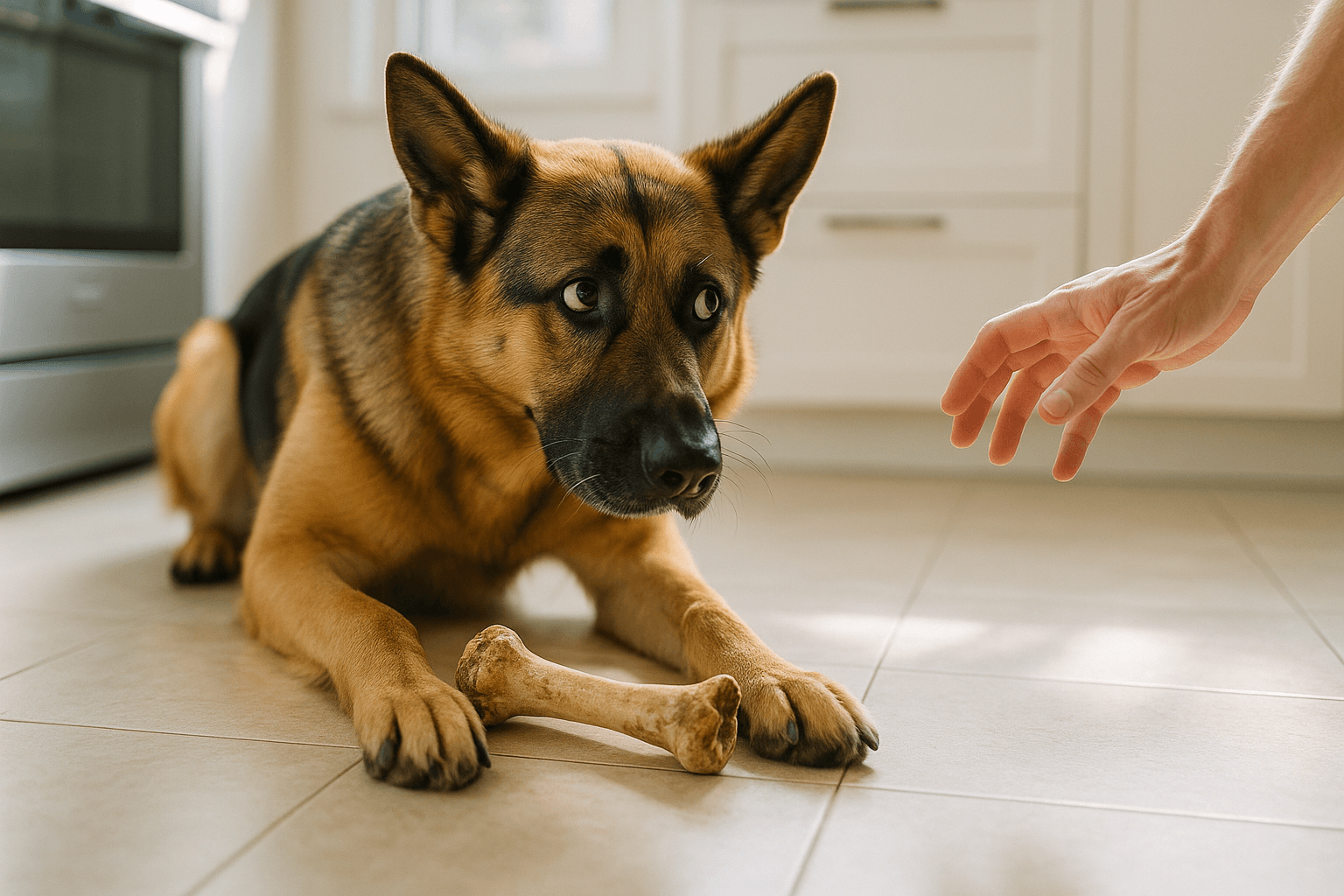
Resource guarding is any behaviour a dog uses to keep people or other animals away from something they value. The resource can be food, a chew, a toy, a resting place, a person or even a location such as a doorway or a piece of furniture.
Guarding behaviours exist on a spectrum:
- Mild: eating faster, moving away, covering the resource with the body, stiffening
- Moderate: freezing, hard stare, low growl, showing teeth
- Severe: snap without contact, bite with contact
Every dog on this list is communicating the same thing: "this is mine and I want you to move away." The difference is in how clearly and urgently they are expressing it.
Why Punishment Makes It Worse
The most common response to guarding, particularly growling, is to punish the dog: telling them off, taking the item away, or physically intervening. This is counterproductive and dangerous for two reasons.
First, it suppresses the warning signals (growling, stiffening) without changing the underlying feeling. A dog that has been punished for growling does not become comfortable with approach: they become a dog that bites without warning, because warning has been punished out of them.
Second, it teaches the dog that your approach predicts something bad. This increases the anxiety around approach, which increases guarding behaviour over time.
The Blue Cross advises that a dog growling is communicating important information. The appropriate response is to respect the communication and change the situation, not to punish the communication.
Understanding the Trigger Hierarchy
Not all resources are guarded equally. Most dogs have a hierarchy: they may be completely relaxed about people approaching their food bowl but very tense about a high-value chew. The assessment begins with identifying exactly what is guarded, from whom, and at what intensity.
Common resource hierarchies (from typically lower to higher value):
- Dry kibble in a bowl
- Wet food
- A toy
- A stolen or forbidden item (often guarded most intensely)
- A high-value chew (bully stick, bone, pizzle)
- A sleeping spot
- A particular person (this is called possession aggression of a human resource and is more complex)
Safe Management First
Before any training begins, manage the situation to prevent incidents. This is not a permanent solution but it prevents the dog from practising the behaviour (which reinforces it) and prevents anyone from being bitten while training is underway.
Management strategies:
- Feed the dog in a separate, quiet space with no other pets or children present
- Pick up high-value chews when visitors arrive
- Remove access to the sofa or bed if those are guarded locations (for the training period)
- Teach children never to approach the dog when they are eating or have a chew
- Do not attempt to take items by force: swap instead
The swap: offer something of equal or higher value before taking the item. "Drop it" trained in a positive, reward-based way is the functional skill that makes item removal safe. Trade up, never take without giving.
Trading and the Drop It Cue
Training a reliable "drop it" or "swap" cue is the practical foundation for managing guarding safely.
How to train it:
- With your dog chewing a low-value toy, approach calmly
- Offer a high-value treat in a closed fist near their nose
- When they drop the toy to investigate the treat, say "yes" and open your hand
- Return the toy to them immediately after the treat
- Repeat many times with low-value items before moving to higher-value ones
The critical part is returning the item. The dog must learn that giving something up does not mean losing it permanently: you are trading, not taking. Over time, they come to welcome your approach during chewing because your approach has been consistently paired with something good.
Behaviour Modification for Guarding
For dogs with moderate to severe guarding (growling, snapping or biting), a full behaviour modification programme rather than just management is needed. The approach is called desensitisation and counter-conditioning: changing how the dog feels about approach by pairing it with something they value.
Basic approach for food bowl guarding:
- Begin at a distance where the dog eats comfortably without any tension
- Walk past the dog at that distance, dropping a high-value treat near their bowl as you pass
- Repeat many times over several sessions
- Gradually decrease the distance of your pass, continuing to drop treats
- Over time, build to approaching, dropping a treat into the bowl, and moving away
- Eventually build to approaching the dog while they eat without tension
The dog is learning: "when a human approaches while I have food, good things happen." This changes the emotional response to approach, which changes the behaviour.
Never:
- Reach towards the bowl while the dog eats until very late in training
- Use a stern voice or forceful body language during the training process
- Progress faster than the dog's body language indicates they are comfortable with
When to Get Professional Help
Resource guarding that involves snapping or biting, guarding of multiple resources, or guarding of people requires professional assessment. A clinical animal behaviourist (CCAB or ABTC registered) or an APDT or IMDT accredited trainer with demonstrated experience in this area should be involved.
Resource guarding is also a welfare concern for other pets in the household: multi-dog households where guarding causes conflict need a structured management and behaviour plan.
Costs for professional help in the UK: approximately £60 to £150 per session for a clinical animal behaviourist.
Breed-Specific Notes
Cocker Spaniels: resource guarding can be a feature of what was historically called "rage syndrome" in this breed, now better understood as idiopathic aggression with a low threshold. Guarding in Cockers that appears disproportionate in intensity to the situation warrants veterinary assessment.
Rottweilers and guarding breeds: naturally possessive dogs. Early training to build comfortable exchange habits from puppyhood is highly effective at preventing guarding from developing.
Terriers: typically possessive of toys and chews. The same counter-conditioning approach applies; terriers tend to respond well to high-value food as a trade incentive.
Rescue dogs: many rescue dogs arrive with guarding behaviours that developed in kennels or previous homes. These are almost always improvable with patient counter-conditioning. Do not rush the process and avoid any confrontational approaches.
For broader training guidance, see our Dog Training Hub. For help finding a qualified trainer or behaviourist, see our guide to Finding a Good Dog Trainer UK.
Frequently Asked Questions
Is resource guarding normal?
Yes. Resource guarding is a normal canine behaviour rooted in survival instincts. It becomes a problem when it is intense enough to cause injury or prevent normal household management. Most guarding can be significantly improved with appropriate handling and training.
Should I take things away from my dog to teach them not to guard?
No. Repeatedly taking items trains the dog that your approach predicts loss, which increases guarding behaviour over time. Train a swap or drop-it cue instead, always exchanging for something of equal or higher value and returning the original item during training.
My dog only guards from children. What should I do?
This is a significant safety concern. The first priority is strict management: children should never approach the dog when they have food, a chew or a valued toy. This should be enforced as an absolute rule regardless of training progress. Seek professional help: a behaviourist can assess the specific triggers and design a safe behaviour modification plan.
Can resource guarding be completely eliminated?
For most dogs, guarding can be reduced to a level that is safely manageable in everyday life. Complete elimination of the underlying predisposition is not always achievable, but comfortable, functional management is. Some dogs will always need management around very high-value resources.
My dog guards the sofa or bed. Is this dominance?
No. Dominance theory as an explanation for dog behaviour was discredited decades ago and is not supported by current science. Guarding a resting place is resource guarding of a comfortable location. Manage by removing access during the training period, and train a "off" cue with positive reinforcement before rebuilding access with clear rules.
My two dogs guard from each other. What do I do?
Feed separately, remove high-value chews when both dogs are in the same space, and manage access to valued resting spots. Multi-dog guarding situations can escalate quickly: seek professional help from a trainer or behaviourist with multi-dog household experience.
Frequently Asked Questions
Yes. Resource guarding is a normal canine behaviour rooted in survival instinct. It becomes a problem when intense enough to cause injury or prevent normal household management. Most guarding can be significantly improved with appropriate handling and training.
No. Repeatedly taking items trains the dog that your approach predicts loss, which increases guarding over time. Train a swap or drop-it cue instead, always exchanging for something of equal or higher value and returning the item during training.
This is a significant safety concern. Enforce a strict rule: children never approach the dog when they have food, a chew or a valued toy. Seek professional help immediately: a behaviourist can assess the specific triggers and design a safe behaviour modification plan.
For most dogs, guarding can be reduced to a safely manageable level. Complete elimination of the underlying predisposition is not always achievable, but functional management is. Some dogs will always need management around very high-value resources.
No. Dominance theory as an explanation for dog behaviour was discredited decades ago. Guarding a resting place is resource guarding of a comfortable location. Remove access during training, then rebuild with a trained 'off' cue using positive reinforcement.
Feed separately, remove high-value chews when both dogs share a space, and manage access to valued resting spots. Multi-dog guarding can escalate quickly: seek professional help from a trainer or behaviourist experienced with multi-dog households.
More from Dog Training
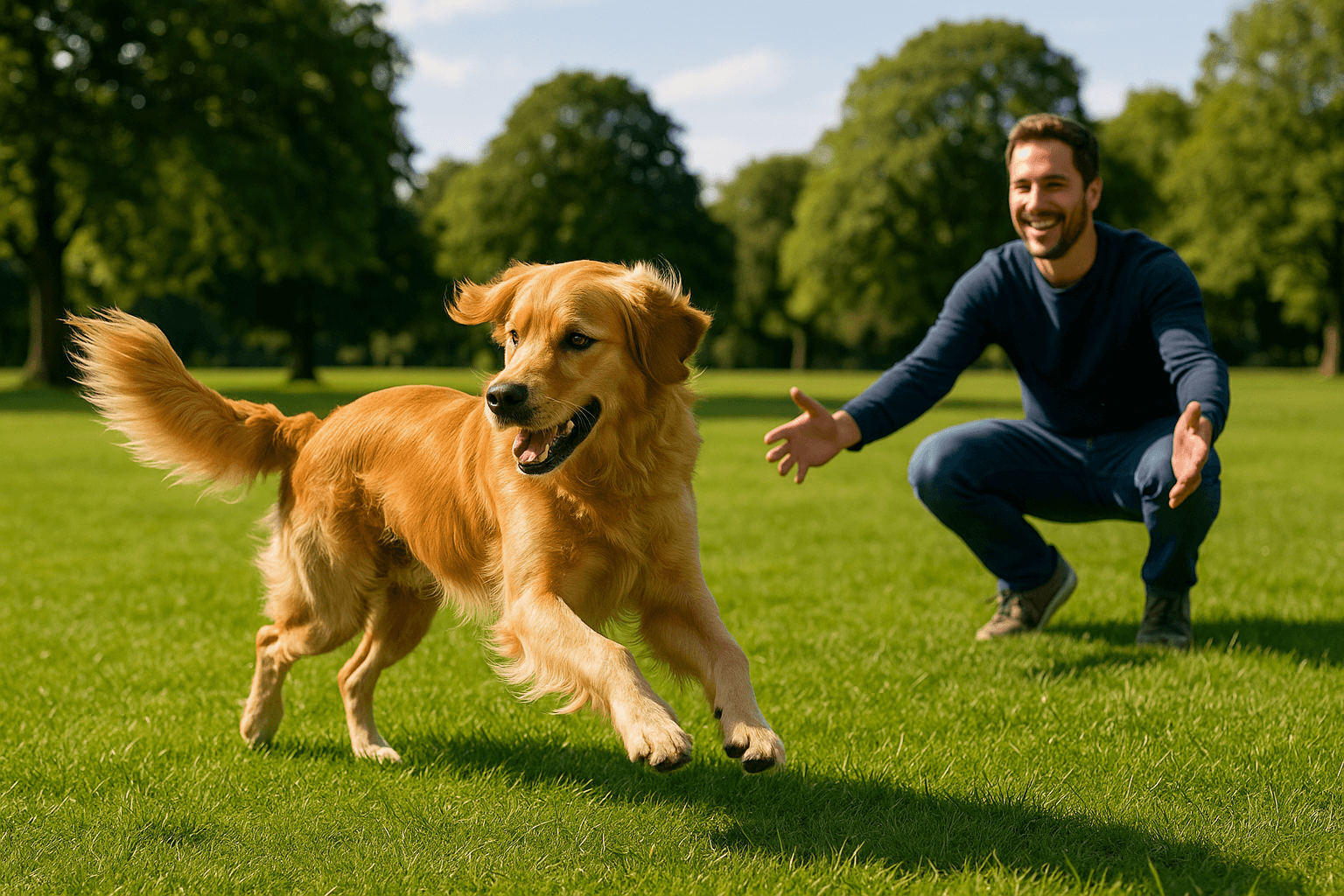
How to Train Recall: The Most Important Skill Your Dog Will Learn
Training a reliable dog recall requires charging the cue indoors first, then building up through a long line to real-world environments gradually. Never call your dog for something they dislike, always reward a return regardless of speed, and use high-value treats like chicken or cheese rather than kibble when competing with outdoor distractions.
Read guide →
Loose Lead Walking: A Step-by-Step UK Guide
Loose lead walking is trained using the stop-start method: stop the moment the lead tightens, move forward the moment it slackens. A front-clip harness or head collar helps manage pulling while training is underway. Consistent application by everyone who walks the dog is the single most important factor in how quickly the behaviour changes.
Read guide →
Dog Separation Anxiety: The Complete UK Guide
Separation anxiety is the most common behaviour problem in UK dogs, affecting approximately 50% of dogs according to Dogs Trust research. Signs include barking, destructive behaviour, and toileting when left alone. Treatment combines gradual alone-time training, environmental management, and in some cases calming supplements or veterinary support.
Read guide →